Words for 2026
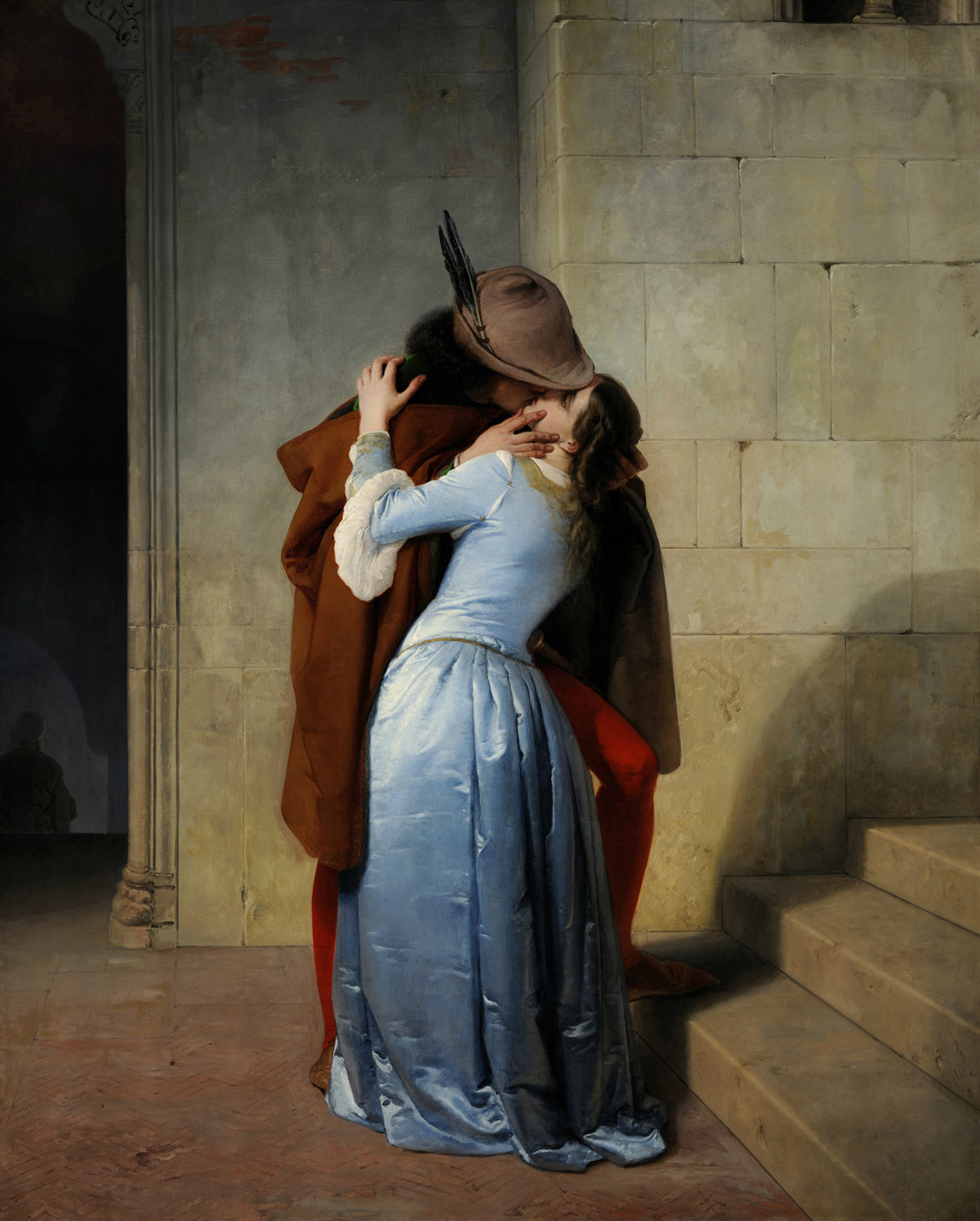
The Kiss by Francesco Hayez, 1859
I like it. Or I don’t like it. We say this when we choose a coat or a house, when we taste grandpa’s “minestrone” or look at Hayez’s The Kiss, when we prefer a life spent in an armchair or a life of recklessness. More than answers, they resemble instinctive, gut reactions: to say I like or dislike something, there is no need for lengthy evaluations or complex calculations; the answer is rather quick, sometimes instantaneous, often without a real reason, given after the fact. I like or dislike are not based on logic that is the same for everyone. Do you like something or someone? Then you are already excited, even if the reasons for your liking are inscrutable, they are certainly unique.
Unique. Each of us has our own likes and dislikes, patiently formed since childhood. These are subjective impressions resulting from experiences that we consider more or less pleasant or that bring advantages or disadvantages. If the experience was good, then the rating is a like; otherwise, it is a dislike. Likes and dislikes constitute, in a wonderfully simplified way, our system of approval or disapproval of things: if I like it, it’s a yes; if I don’t like it, it’s a no: on-off, like a switch. If I like it, I buy the coat; if I don’t like the minestrone, my grandfather eats it. They also form our database: likes and dislikes give qualitative value to experiences, guide both insignificant and relevant choices, and populate our memory.
Memory. È qui che conserviamo traccia delle impressioni, dei loro effetti e i già noti mi piace e non mi piace. La memoria funziona da archivio dati, da essa possiamo richiamare i contenuti e farli rivivere come se accadessero ora. Basta rievocare l’esperienza e – oplà – il primo bacio alla persona amata succede magicamente proprio adesso, nitido e intenso nonostante sia avvenuto un giorno o una vita fa e ricordare chiaramente quanto sia stato bellissimo e per questo essere piacevolmente indimenticabile. Ma di memoria ci si può anche torturare, puoi rimanere impigliato in un brutto ricordo difficile da lasciare o credere che il tempo non sia mai trascorso senza che abbia medicato alcuna ferita. Piacevoli o meno stiamo parlando di esperienze i cui effetti possono farsi sentire così tanto da sembrare veri, ma attenzione, sono impressioni. Per evitare i trabocchetti della memoria bisogna avere una certa maestria.
Mastery. Remarkable skill developed in the practice of a craft or art form. To achieve mastery, you need sensitivity, as if it were love; intuitive ability to know which direction to take, as if it were the most natural thing in the world; precision in your movements, as if it were an indispensable necessity; tirelessness in your research, as if there were no end in sight; great courage when you have to start over, as if it were the only way to learn; and a sea of patience, as if it were an endless expanse to cross. Any activity can be performed with mastery; it is a matter of choice and you don’t need to be an artist. Mastery is a personal attitude; it has a quiet dignity. When mastery is expressed, it becomes a universal good, reverberating with a life of its own regardless of its author. This means that mastery has its own intrinsic intelligence.
Intelligence. Artificial intelligence is the star of the moment, it is the buzzword. Many objects and functions are now equipped with this kind of intelligence, and we are now able to do more things, more efficiently and at an impressive speed. Professions are changing, as are ways of thinking and, consequently, ways of perceiving. However, despite the undeniable advantages, there are those who are not in favour of this unprecedented form of development, who harbour fears and are against it: the wave of innovation is sweeping away tried and tested methods and established procedures, things will never be the same again, technology will prevail, who knows where we will end up. It’s true, who knows where we will end up… but this was also true before, with human intelligence alone. All that remains is to welcome and embrace the new: we need new teachers and future masters.
Words for 2025
By feeling. It is a process design that acts on few assumptions and incomplete data. “Feeling” design is participatory, the design is not by a single author but shared by a collective, its mantra has one word: ”let’s try.” Thus, the key is in the unfolding, a path of slow refinement conditioned by subjective feelings. Form is defined through progressive adjustments to reach the final result. It is loved by clients somewhat less by designers, particularly, those who have their own stainless idea. It is tentative to the last and aspires, despite the meagreness of the premises, or perhaps because of them, to a wow-effect result.
Wow. In the world of brands, wow is a coveted effect. It happens when a brand goes beyond expectations to such an extent that it leaves you speechless or, indeed, just with a wow. The bet is to amaze – and if I amaze you, you will like me, you will want me and you will come back to me… The point is to have a substance so attractive that it generates such amazement which not all brands have. By substance is meant a set of qualities such as the ability to create a product, innovation or service, taken care of with such attention and meticulous precision as to verge on perfection.
Perfection. It would be nice if everything was perfect, but it’s not anyway. So let us relax! For this we are helped by Wabi-sabi an Eastern view that suggests acceptance of the impermanence and imperfection of things by recognizing three truths: nothing remains, nothing is concluded and nothing is perfect. At first glance, the principle may sound a bit resigned but, on second thought, it avoids futile efforts to reach impossible goals. This impermanence, however, is no excuse for sloppy doing. The goal is not perfection but to value things through one’s own skill, the best available, with a specific look.
Gaze. Let’s take a Lady Dior and a Kelly by Hermès. Even before being two bags, they are ways of interpreting the same object, two different logics, two distinct looks. The look defines style, a unique language for inventing universes. Are we talking about fashion? Not only that, also about all the ways of creating and doing that we can imagine. Style is recognizable and difficult to describe, more a matter of feeling than reason. But how does one learn it? Style is transmitted, to understand it it must be taken on, it must be breathed in as if it were air.
Air. To the ancient Greeks it was the seat of souls; technically it is a mixture of nitrogen and oxygen. It is measured in liters and we breathe in about six per minute, in twenty-four hours we “drink” more than eight thousand five hundred. Air trumps mind: just don’t breathe for a minute and we start to have a serious problem. Instead, if we do not think for a minute, we breathe even better. Air envelops the Earth for a hundred kilometers then vanishes into interplanetary space. In this infinite vacuum our ball floats suspended with us on board. When we notice we are breathing, that is, when we realize we are alive, let us remember how much grace.
Words for 2024

Ph. Devon MacKay / Unsplash
Corner. Concave, convex, acute, obtuse, straight, flat, round… In the panorama of angles there is also the dead one. It is infamous for being a road hazard, the damnation of rear-view mirrors. It must be said that this corner, even before being dead, is blind. Indeed, in the space it defines, it is certainly difficult to see but not necessarily to die. Tuttavia, vista la probabilità di lasciarci le penne, all’angolo è stata tolta l’innocenza, è stato dichiarato morto – per non dire mortale – diventando così un angolo privo di speranza.
Hope. A feeling that one nurtures, sometimes futilely, to achieve uncertain results. The greater the interest in the goal, the greater the hope; when interest is low, hope goes accordingly. Together with determination, courage and endurance, they form a compact quartet striving for the goal. If the outcome is different from what was expected, of the four it is the last to die, hope has crazy resilience, it does not give up until the end, it is capable of defying contrary evidence. Once the limit has been crossed, however, there is nothing left but to invoke a benevolent god, rely on a saint or abandon oneself to fate.
Fate. Mysterious force that regulates men’s lives in unpredictable ways. Divided into good and bad, the universal preference is clearly in favour of the former. For this quality, the most explosive combination sees Fortune and Talent acting together. While luck seems an occasional, gratuitous blessing from heaven, talent is an innate endowment, the spontaneous exercise of a special ability, a flow that is anything but fortuitous. Precisely because of its unstable nature, one would think that luck is of less importance than talent. Instead, she is almost always so decisive that she alone is enough to solve everything. And let talent be doubted as if it were an optional extra.
Optional. Coming into the world and receiving an instruction booklet would be a great help. A car, a blender, a washing machine have it, we humans do not. A handbook to keep at hand, a summary of the operating characteristics of one of the most amazing machines on the planet with a system of operation honed over millions of years. A practical handbook that includes the distinctive aspects of the species, how the body, mind and feelings work and how to deal with them, such as the safety rules to adopt, the care and maintenance to do, how to behave when something goes wrong. And to know from the outset, whether happiness is an integral part of the system or an optional extra, an extravagant idea or an anomaly.
Anomaly. Certainly it is a nuisance, it spoils a calculated plan, it disturbs a supposed idea of perfection in its linear unfolding. But let’s consider the positive side of the anomaly: it allows us to identify a defect to be corrected, to fix something broken or to find even more effective solutions. The anomaly is a trigger for action. It encourages careful observation, cultivating healthy criticism, holding high the values of rebellion. It takes an anomaly to make progress. That’s a lot for an irregularity, isn’t it?
Words for 2023

Winning. The Russian-Ukrainian conflict can be seen from different perspectives. Two, in particular, are perpendicular to each other. The first is the subjective view of the soldiers, a man-high, horizontal, moving view. The second is the subjective of drones, an overhead, vertical view, stabilised by satellites. The first vision scans the horizon to be conquered, the second frames it as a target. The perpendicularity of the views is reminiscent of those in action video games, the ‘kill-em-ups’: a dash to find the enemy and a map where to find him to take him out. The virtual game resets the dramatic dimension of reality by focusing on achieving victory. We enjoy winning a lot, not just pretending, more than anything, from the real thing.
Real. Or false. Right or wrong. Good or bad. Win or lose. Who knows how we got into this mechanism, a dualism that demands a lot of energy and generates conflict: maintaining an acceptable balance is challenging and does not lead to lasting results. Given the often disastrous effects, the debate could be shifted to a purely immaterial level, including wars. An abstract space, a virtual room where they can continue to misunderstand each other and beat each other at will like in a video game. That way we can save ourselves the blood and mud of real life and, perhaps, think about more noble business.
Business. That is, exchange of goods or services. It is such a human activity that it seems to belong only to us. Instead, other living species practice it, among them, wasps. The little ones in the nest are fed by the adults, who receive a sugary slime in return. The larvae release the liquid as a reward for ‘room service’. The phenomenon is known as trophallaxis a way of exchanging food, sweetness and cuddles all at once. Exchange produces collective trust, keeps the internal social system in balance and feeds a virtuous circle.
Virtuous. So was Niccolò Paganini, the famous Genoese musician, but no less so was Giuseppe Guarneri del Gesù the luthier who built the two violins that belonged to the maestro between 1742 and 1743. The incredible skills of the musician and craftsman are a shining example. They illuminate the fact that knowing what one’s virtue is and expressing it is important and necessary, it is good for those who have virtue and for all those who can enjoy its effects. The names of the violins? The first is ‘Carrodus’, the second is ‘Cannone’ (Cannon) named by Paganini himself for its sonorous power. Today, tools are invaluable. The ‘Cannon’, for example, is estimated at eighty million euro. Virtue is transformed into value and goes far beyond its tangible meaning.
Tangibile. True, ours is an insecure world where deep-seated injustices and nasty viruses coexist, a tiring and unpredictable place. This uncertainty justifies the search for parallel worlds and the creation of immaterial ones where everything could be easier and perhaps fairer. Yet, it is through matter that we are able to make masterpieces and miracles. As long as an alternative is an abstraction, it is still not revolution.
Words for 2022

Horizon. That seemingly endless space into which we can stare where the sky seems to touch the earth or the sea. When we lose sight of the horizon, we lose our sense of direction, but when it is clearly visible, it is an inspiration. Especially when we can dream. Just to look at it is to breathe.
Breathe. The mechanical phenomenon that refreshes the air in our lungs. A physiological process that exchanges carbon dioxide with oxygen through the extraordinary surface of our pulmonary alveolus: which, in humans, is estimated to cover an area equal to an apartment of between 60 and 90 square metres. Like all aerobic beings, we breathe air to live, including the air of freedom.
Freedom. A broad and abstract concept with significant practical implications but with elusive borders. From a legal point of view “signifying, in principle, the right of each individual to act or change without constraint” Therefore, a personal concept that confronts and often clashes with the freedom of others and with the aforementioned “principle”, a distinction that should however meet with the agreement of everyone.
Everyone. We are one, but we are not the same. Moreover, we are many. And, as always, it is easy for us to be one against the other: all it takes is an idea, an ideal, a flag, a team or a virus, and the game is on. But what if we tried to turn down the volume in our one against the other? And perhaps listen for some new sounds? Can we do this?
We can do it. So said Frederick, the famous university professor and grandson of Victor von Frankenstein. Do you remember? In the cult film Frankenstein Junior, Frederick rejects his grandfather’s visionary ideas but checking his notes he changes his mind and gives life to the “Creature”. Unfortunately, the experiment does not go well: confirming the unpredictability of the results despite the certainty of the assumptions. In short, something goes wrong, just like in everyday life, for everyone. Does that not sound familiar?
Words for 2021

Special Covid19
Coexistence. It takes courage to be with something measuring between 60 and 140 nanometres (1 nanometre = one millionth of a millimetre) but capable of unleashing pandemonium. In fact, it’s lethal, is airborne, meaning that you risk breathing in disaster. Sure, we have said that we need to live with, not fight against. But a battle against the invisible is not a fair fight in terms of insidiousness and strength, Covid-19 is superior, so we are obliged to play in defence, barricade ourselves in. And above all, it unleashes the fear of suffering or dying.
Division. Like all viruses, it makes no social distinctions, reactions to its effects are not the same for everyone, and for some it signals the end. But the virus does its job as a parasite and the result is division, not its, but ours. On one side we have the terrorised, on the other the reckless, and, in between, the worried, the cautious, the fatalists, the sceptics and so on: we are divided, a tactical and strategic error. Sticking together means welcoming our diversity. Fear is a part of us, so it makes no sense to use it to recriminate or condemn in order to be on one side or the other.
Broadcasting. As the virus takes its course, our division generates confusion. And the noise is amplified. On social media we are all broadcasters of news, both good and bad, true and false, all mixed up together. The mix varies according to what we feel and what we broadcast as a result: if you are terrified, you will be a broadcaster of terror. In the name of sharing, we produce scraps of media content that float across our conscience. What’s left is a panorama based on distorted information that can only be read approximately. Facts are facts, how they are read does not always reflect what they are.
Fragility. So, the emotional front is fragile, the picture is complex, the future uncertain. To these difficulties must be added the conflicting opinions of those who should offer us certainties and reassurance: those who operate the levers in this silent storm. Unfortunately, this is not the case. On the bridge, decisions must be taken faster than the spread of the virus: an impossible demand, even on paper.
Distance. To slow down the stubborn propagation, we mask-up to avoid “spitting in our faces” and transforming our cities into unlimited recovery areas outside hospitals. Mistaking it the physical equivalent, we praise “social distancing”, forgetting that physical and social distance are two different things, just like “remote working” and “smart working”. In other words, no longer pay attention to the use of words that still confuse us. The greatest distance, however, risks being the distance from ourselves; losing the inner centre, which is our base, as we seek the protection of domestic caves while trusting in a redeeming technology.
Ahead. While remaining in a cave has a useful function, we can also see that – in the big picture – many roads are closed off. We can also call them habits, or narrow views, comfort zones, models… whatever we prefer. But at the same time, other new and uncertain ways are opening up. To move forward, we need to be able to distinguish between true and false, refine our intuition.